Life is a Game
a guide on how to play it correctly

For most of my life, I thought life was a test.
Every decision. Every person I dated. Every year of my twenties. Like if I made the right moves — right city, right career, right person, right version of myself — then one day I’d finally pass.
But lately I’ve started to think the whole frame is broken.
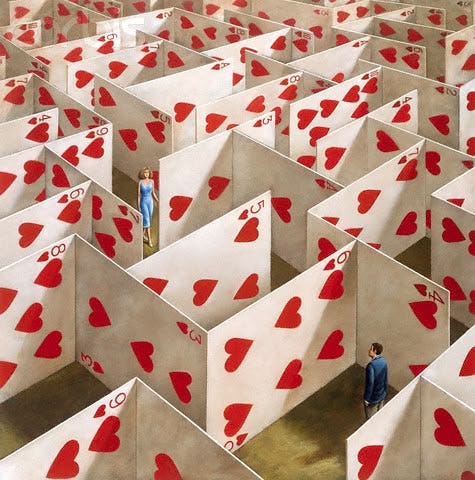
Maybe life was never a test. Maybe life is a game.
(You can watch the video version here)
I. Most people are playing a game they didn’t choose
The first game I ever learned how to play was the college admissions game.
Get good grades. Take the hardest classes. Do the extracurriculars. Build the résumé. Be well-rounded, but also exceptional, but also humble, but also impressive in a way that could be summarized in 650 words. Super easy. Very normal thing to ask of a seventeen-year-old.
For a long time, I really believed there was one path. Get into the good school. Become the right kind of person. Unlock the right life. And if I didn’t, some door would close forever.
My entire childhood became this long, convoluted game I never remembered agreeing to play. Join this club. Take this AP. Volunteer here. Get the leadership position. Become passionate, but strategically. Become a full human being, but one who could be flattened neatly into bullet points.
And I’m not saying any of this is evil. I learned a lot. I worked hard. I became disciplined.
But the dangerous part of any game is when you start believing the rules are reality. When you start believing the scoreboard is the truth.
And my scoreboard was very clear. Good grades meant good person. Good school meant good future. Rejection meant you did something wrong.
When you believe that for long enough, you stop asking what you actually want. You just ask what will make you look like you’re winning.
That was the first game I remember playing: the game of being impressive.
The thing about the game of being impressive is that it never really ends. You think it ends when you get into college. Then it becomes internships. Then jobs. Then cities. Then apartments. Then relationships. Then whether you’re doing enough by twenty-two, twenty-five, thirty.
There is always another level.
But spoiler: I didn’t even pass the first one.
I didn’t get into an Ivy League school. And at the time, that was the trophy. That was the proof. That was the thing I thought would tell me I had done childhood correctly.
So when I got rejected, it didn’t just feel like a school didn’t want me. It felt like the whole game had ended. Game over. Test failed. Please restart your life.
But here’s the strangest thing. It was only after getting rejected from ten colleges that I started uploading YouTube videos. It was only because the door I worshipped didn’t open that I started looking for another one.
I thought rejection was the end of my life. But it might have been the first time my life actually became mine.
II. A game is different from a test
This is why the difference matters.
A test has one correct answer. A game has many strategies.
A test says: don’t mess up. A game says: learn the mechanics.
A test says: prove you are good enough. A game says: try things and gain skill.
A test makes one wrong move feel like failure. A game makes wrong moves part of how you get better.
When I thought life was a test, every decision felt fatal. If I chose the wrong city, wrong career, wrong person, wrong outfit, wrong version of myself — it meant something about me. If I failed, it meant I wasn’t talented. If I changed my mind, it meant I was inconsistent.
But in a game, a wrong move is not an identity. It’s information. It tells you what doesn’t work. It shows you where the wall is. It teaches you the map.
You don’t play a game for the first time and expect to understand the entire world immediately. You wander around. You press the wrong buttons. You talk to random characters who maybe matter later. You enter rooms that lead nowhere. You lose lives (not literally). You restart. You discover that some doors only open after you’ve learned something else.
Maybe life is more like that than we want to admit. Maybe some things don’t make sense yet because you haven’t unlocked the next part of the story.
And that’s the inspiring part. Not that life is easy. Not that every failure secretly has a perfect reason. Not that rejection doesn’t hurt, or humiliation doesn’t sting, or losing something you wanted doesn’t make you want to rot in bed and order a $24 salad.
But games are meant to be played. Failed at. Restarted. Explored. Eventually mastered.
A test makes you freeze because every answer could be wrong. A game lets you move because every move teaches you something.
III. What game are you playing?
Where “life is a game” gets dangerous is when people hear it and think the point is to win harder. More money. More beauty. More status. More followers. More attention. More proof.
The problem isn’t that people treat life like a game. The problem is that they never ask which game they’re playing.
Because every game has a different prize.
The status game says the prize is being admired. The beauty game says the prize is being desired. The comparison game says the prize is proving your life is better than someone else’s.
But then there’s another game. The aliveness game. And that game has completely different rules.
The prize is not being the most impressive person in the room. The prize is feeling like you are actually in your life. The prize is making things that feel true. The prize is becoming more yourself instead of more palatable.
That’s the game I’m trying to play now. Not because I don’t care about success. I clearly care. I am literally on the internet. But because I don’t want to build a life where I technically win and privately disappear.
I don’t think the goal is to stop playing games. I think the goal is to choose a better one.
IV. Play is where the self comes back
If the aliveness game has a different prize, it also has a different way of playing. And the mechanic is something I’d basically forgotten how to do: play.
There’s a psychiatrist named Stuart Brown who has a line I haven’t stopped thinking about. He says, “The opposite of play is not work. It’s depression.”
Which sounds incredibly dramatic. Like, okay Stuart, I just said I don’t have hobbies.
But I think what he means is that when you lose play, you lose vitality. You lose spontaneity. You lose the part of you that can still be surprised by your own life.
There’s another psychoanalyst, Winnicott, who wrote about the true self and the false self. He believed that play is where the real self comes out. It is in playing that a person becomes creative, uses the whole personality, and discovers the self.
The false self is really good at tests. The false self knows how to comply. How to perform. How to become legible. How to figure out what the room wants and become that.
The false self is great at college applications. It knows how to be well-rounded. It knows how to be impressive. It knows how to turn a childhood into a résumé.
But the true self is usually less efficient.
The true self wants to make a thirteen-minute video about one sentence that ruined your life. The true self wants to spend three days writing an intro that maybe 40 percent of people will read. The true self wants to bring up Darwin’s orchid in a dating advice video because, for some reason, that feels emotionally necessary. The true self wants to make something beautiful even if it does not immediately convert into money.
I think that’s why YouTube started to feel different for me this year. Because on paper, pivoting harder into it made almost no sense. Longer videos. More effort. Fewer sponsors. Less immediate money. More vulnerability. More time alone in my apartment wondering if I’m having a revelation or just being unemployed with better lighting.
But it felt meaningful. For the first time in a while, I felt like I wasn’t just feeding a machine. I was making something. Something with a beginning, middle, and end. Something I could put my brain inside. My memories. My weird little references. My dramatic inner monologue. My need to turn every emotional inconvenience into a life lesson.
It felt like play. Not because it was easy. But because more of me was there.
V. Start playing your own game
I don’t think play means not caring. I think play is what becomes possible when you stop confusing fear with seriousness.
For a long time, I thought I was being mature when I was really just scared. Scared to look stupid. Scared to be misunderstood. Scared to try and have people see me trying.
Children play because they don’t yet believe every mistake is a referendum on who they are. Adults stop playing because we become obsessed with being perceived correctly.
We would rather be impressive than curious. We would rather be safe than alive. We would rather have a perfect plan than an interesting life.
And I think that is such a tragic trade. Because the people I admire most are not the ones who never lose. They’re the ones who stay in motion. The ones who try strange things. The ones who let themselves be beginners. The ones who understand that embarrassment is sometimes the price of entering a new level.
So I’ve started trying to change the rules — not to win a different game harder, but to actually feel like I’m in the one I’m playing.
Instead of asking, “How do I look?” — “What am I learning?”
Instead of “Am I behind?” — “What level am I on?”
Instead of “Did I fail?” — “What skill did this unlock?”
Instead of “Was this embarrassing?” — “Did I gain courage points?”
Instead of “Does everyone understand me?” — “Am I becoming more myself?”
I know that sounds a little cringe. But maybe that’s part of the point. Maybe the version of your life that feels most alive will always look a little cringe to the version of you that was trying to be untouchable.
I don’t have a neat conclusion for this, because I am still very much inside the game.
I still want things. I still want success. I still want money. I still want my work to matter. I still want my life to feel beautiful and impressive and meaningful and, ideally, not financially irresponsible.
But I’m trying to notice when ambition starts turning me into someone I don’t like. When I’m performing instead of playing. When I’m chasing proof instead of making meaning. When I’m trying to win a game whose prize I don’t even want anymore.
And I think that’s the whole thing. Not quitting the game. Not pretending you don’t care. Just pausing every once in a while to ask:
Who made these rules?
What am I trying to prove?
And what would I do if I remembered I was allowed to play?
Because I don’t think I want a life where the prize is just looking like I won.
I think I want a life where the prize is feeling like I got to play.
so inspiring!! seeing people starting to show wonder and a kind of fearlessness in this harsh world is very comforting. thank you!
Love it